

 Written by
 [ad_1]
Vacation Rental Host Guide How Does Bookingcom Work
Key Takeaways
- Learn Booking.com’s commission structure, cancellation policies, how the platform handles guest damage, deposits, and the review system (who can rate whom and how).
- We walk hosts through the process of creating an account and completing their Booking.com profile step by step.
- Compare Booking.com and Airbnb side by side.
- Find out what it takes to succeed on this OTA, and learn how to be present on multiple OTAs without running into overbooking issues.
- We answer FAQs about Booking.com that often leave hosts confused.
A private host on Airbnb benefits from expanding to other channels. Among the most promising ones is Booking.com. You might wonder whether it is a booking channel more popular with hotels.
The short answer is no. Vacation rentals get equal treatment on this platform. And you get exposure to travelers and guests worldwide. We did the due diligence for you, and this is what you absolutely need to know about the booking process on this platform.
What is Booking.com?
While it was originally for hotel rooms, the platform has expanded to include a wide range of accommodations. Homes, apartments, resorts, villas, hostels, B&Bs, and guest houses are a few examples of the property types available.
Booking.com is a booking website and accommodation provider owned by Booking Holdings.
They also have other types of offers related to trips beyond accommodation, such as flights, airport taxis, car rentals, or airline tickets.
Who books on Booking?
Today, established brands as well as smaller entrepreneurs use Booking.com. It attracts 100+ million users per month to its own website! Thus, if you list on Booking.com, you will be able to show off your rental to a global audience.
As one of the biggest OTAs in the world, Booking.com truly caters to an international audience. It is accessible to more than 220 countries. What’s more, it offers round-the-clock support in more than 40 languages.
It is well-liked by travelers as most apartments and homes also offer free cancellation. It is especially popular among families and couples with close to 70% of the nights booked by couples and families.
Why Vacation Rental Hosts Should Be on Booking.com
- Global audience reach: Exposes your property to potential guests worldwide, far beyond local markets, drawing international travelers who check prices and availability in advance.
- Total flexibility: Cancellation policies are very flexible in the sense that hosts can create custom rules. Enables instant pricing tweaks (nightly rates, discounts).
- Mobile apps convenience: Hosts and guests use intuitive mobile apps for quick access to booking, house rules, and updates, simplifying management for one property or portfolios.
- Lowest prices appeal: Positions rentals as the cheapest option for price-sensitive guests, often due to no guest service fees.
Booking.com is a commission-based platform. This means that while creating a listing on Booking.com is free of charge, hosts and property managers will have to pay a certain percentage of each reservation.
How does it work?
You owe commission when you collect money from the guest, including:
- Completed stays
- Late cancellations where you keep the fee
- No-shows where you charge the guest (non-refundable bookings)
Many hosts accept online payments, which makes collecting money and paying commission easier. Guests can pay online at the time of booking, so the funds are secured before arrival. Hosts can also accept cash payments.
How much commission does Booking.com take?
The commission percentage varies by country, property type and other factors. The company doesn’t disclose it, but from what we know, this is how it works:
Depending on certain factors, such as location and how you have set up your account, these fees can range from 10% to as much as 25%. For example, if you use the member service recommended by Booking.com, it may increase your commission rate.
Services like the Genius Accommodations Program, Preferred Partner Program, and Visibility Booster improve your listing’s exposure to frequent travelers or higher search rankings, but they do so by adding extra commission on top of your base rate.
Hosts always pay the platform’s fees. Booking.com does not directly charge guests service or booking fees. For this reason, hosts can choose to build the commission into their nightly rate.
How and when do I get charged?
You are charged once a month on Booking.com, and not per booking. At the start of each month, Booking.com sends one invoice that covers reservations with check-out dates from the previous month.
The invoice is issued during the first week of the month, usually on the 3rd or 6th. This depends on where your property is located.
Before the invoice is finalized, you have a short review window. You can mark no-shows, fix prices, or adjust dates until the 2nd or 5th of the month. Once the invoice is issued, you pay the total commission as one monthly payment.
Do I pay commission if a guest never shows up?
If you keep a no-show or cancellation fee, then yes, commission applies. If you mark the guest as a no-show and choose to waive the fee, you do not pay commission. The same applies if you can’t charge the guest because their credit card is invalid.
Do I pay commission on cleaning fees?
The short answer is yes. Booking.com charges commission on the total reservation cost. This includes any additional fees added at booking, such as cleaning fees.
These fees may not always appear as separate line items on the invoice, but they are included in the commission calculation at the reservation level.
What if my commission is higher than I expected?
There are a few common reasons for this. Your base commission varies by country, location, and property type, so it may be different from what you assumed. It won’t be the same price for all property owners.
Your commission can also be higher if you are enrolled in marketing programs like Genius, Preferred Partner, or Visibility Booster, which add extra commission in exchange for more visibility.
You can check your exact rate, invoices, and reservation details in the Extranet (Booking.com’s host management portal) under the Finance section to see where the difference is coming from.
This platform lets you fully customize your cancellation policy.
What cancellation policies are available?
Booking.com gives you flexibility when it comes to cancellations.
The platform recommends that guests be able to cancel for free up to a day or two before check-in. This is great for guests, as they value flexibility.
But, if you prefer, you can set non-refundable policies, where guests won’t get their money back if they cancel.
There are two main ways to set your rules: fully flexible or customized.
- Fully flexible: Guests only pay when they actually stay. They can cancel for free during a time frame you choose before check-in.
- Customized: You decide exactly how long before check-in guests can cancel for free and what they’ll pay if they cancel after that. You can also set prepayment requirements and choose how and when you get paid.
How does a deposit work?
Hosts can charge guests a deposit up front, which theyʼll get back if they cancel within the free cancellation period. If they cancel after that, they wonʼt get the deposit back.

On Booking.com, guests can rate your property on a scale of 1 to 10. They also give scores for things like cleanliness, location, staff, comfort, facilities, value, and free Wi-Fi. These “subscores” are independent of the overall score.
The overall rating you see is a weighted average. Keep in mind that more recent reviews carry more weight.
Reviews generally need to be submitted within three months of check-out.
You can reply to reviews, which is a great way to thank guests or address concerns. When visitors see your reviews, the most recent ones appear at the top, though they can also sort or filter by date, score, or other criteria.
Booking.com has systems and staff to catch fake reviews, and any suspicious content can be reported.
Surely, a strong review score from other guests elevates visibility, as Booking prioritizes top-rated listings to attract more customers.
Can hosts rate guests on Booking.com?
Booking.com does not allow hosts to rate guests. Unlike some platforms, all the review power goes to travelers.
Hosts can respond to reviews, but they cannot give a score or review the guest in return. This keeps the system focused on guest experiences, though your responses let you share your side of the story when needed.
As a host, you can set a deposit to protect your property.
A damage deposit is meant to cover any potential issues. To set it up, go to Policies in the Extranet, click Edit under Damage policy, select Yes for the deposit, and follow the instructions.
Booking.com has a Partner Liability Insurance program that provides up to $1,000,000 in liability coverage per reservation for bodily injury or third‑party claims, but this does not cover damage to your own property.
How to Register a New Property
If you want to list your property on Booking.com, there are a few steps that you need to complete. You will need to register your property, double-check that your profile is complete and decide on important settings.
Registering a property on Booking.com does not take a great deal of time. According to its website, you can complete the process in about 15 minutes. Here is what you need to do:
- Go to Booking.com’s sign-up page to register your property.
- Provide your property’s details (such as the number of available rooms and types of facilities provided), upload photos, add your payment details, and sign the agreement. Please take note that if you have, for example, added a new facility since registering your property, you will also be able to update your details at any time.
- Booking.com will review your registration to make sure that it has received all the required information. After reviewing your details, they will send you a confirmation email with your unique login name.
- You will also receive an email with a link to create your own password.
- After you have set up your login details, you can proceed to log in on the admin dashboard (also referred to as Booking.com’s Extranet).
- Adjust your details, such as calendar and rates, on the Extranet.
A complete profile will help you to secure more bookings. So, take the time to ensure that you upload high-quality photos, write a detailed host profile, and list all the amenities that you provide.
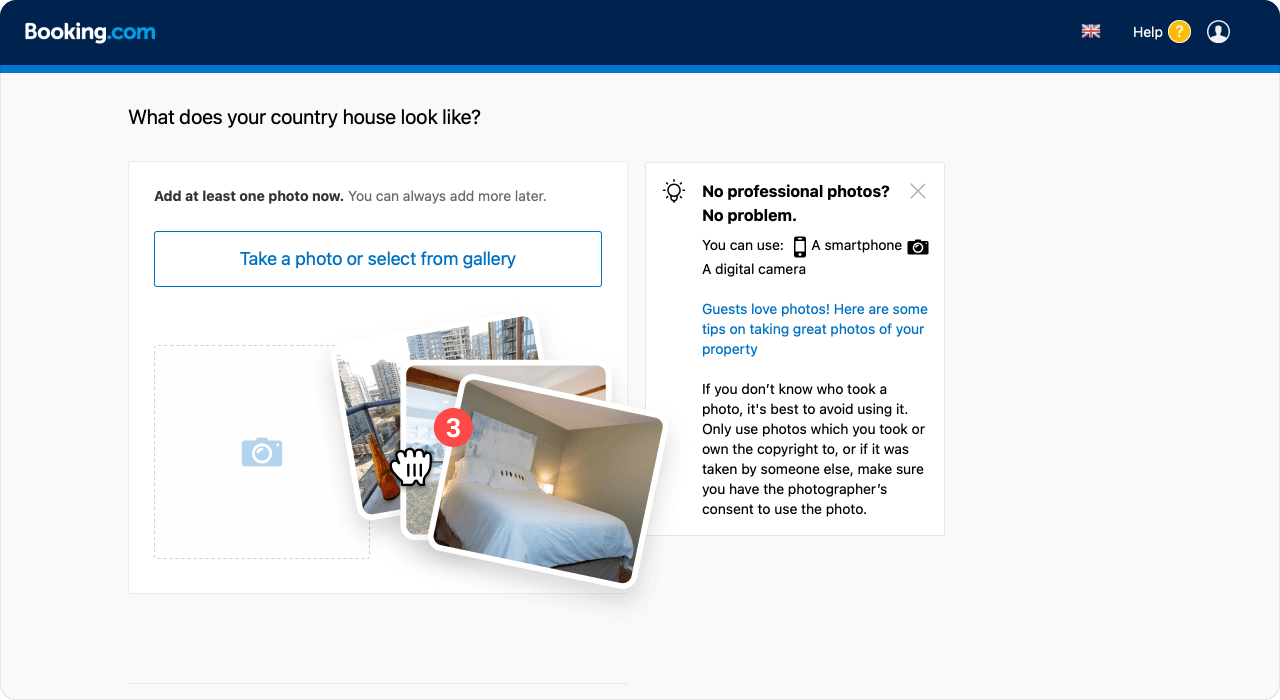
Upload eye-catching property photos
Guests love to browse through photos when they are searching for accommodation. Booking.com recommends that you upload photos that show off both the interior as well as the exterior of your property.
Examples of photos that you can include are decor, surroundings, facilities, and security features.
Provide all the essential details for a property description
Unlike Airbnb, the description of your Booking.com property is automatically created. Booking.com uses information about your location and facilities to generate this description.
It is, thus, very important that you complete this step diligently to ensure that you have provided all the essential details needed to generate it automatically.
The only way that you can alter your property description is if there was a typo or wrong information. In this case, you must use the app to request a correction. If you want to share extra information about your property or location, you can do so by completing your host profile.
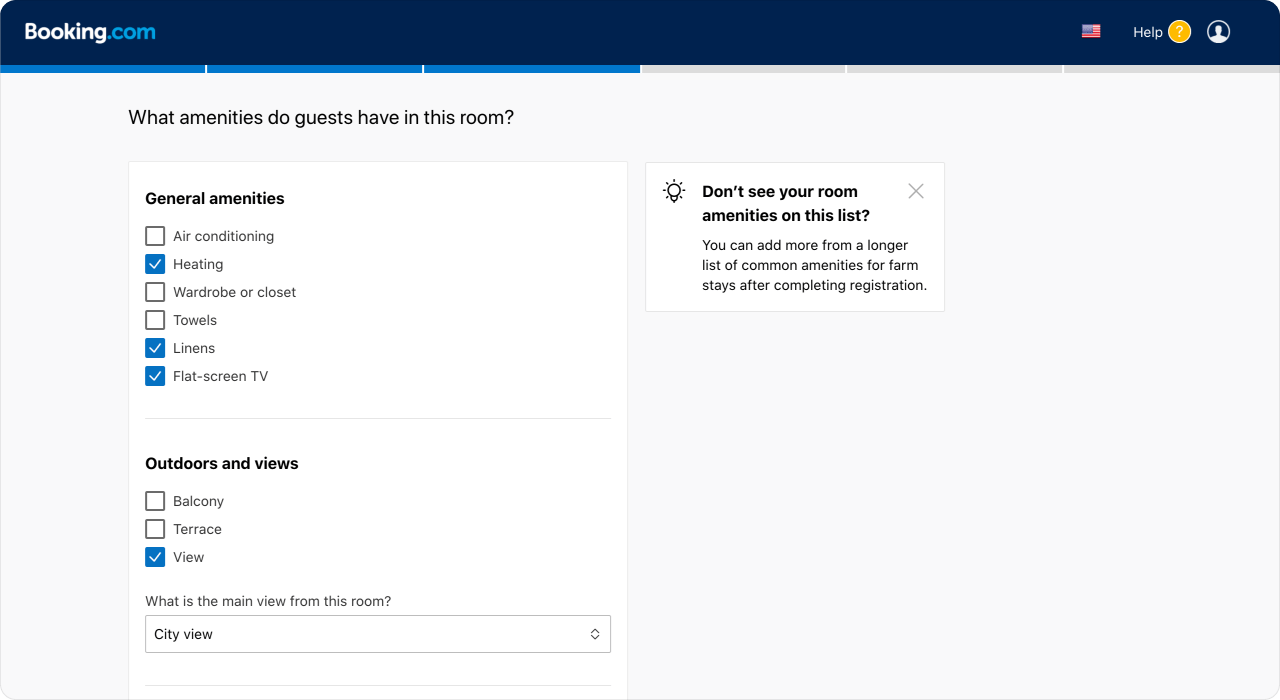
List all your amenities
While it might be time-consuming, it is crucial that you take the time to list all the facilities and services that you provide.
It will help guests to know what they can look forward to and reduce the number of questions that you have to answer about your property.
How to Set Nightly Rates, Fees and Cancellation Policy
As a host, you should pay special attention to the following settings. These are just a few examples.
Rates
It is key that you create rates for different types of occupancies so that your listing appeals to different types of guests. It is also a good idea to ensure that you load your rates well in advance. This way, you will boost your visibility and attract early birds.
If you worry about cancellations, you can opt for a non-refundable rate.
Guests will pay the full price if they cancel at the last minute when you have added a non-refundable rate. On the other hand, you will also have to pay a commission on a booking even if your guest doesn’t show up.
Additional fees
It is a good idea to charge a cleaning fee and a damage deposit. The cleaning fee can be set per stay, night or person.
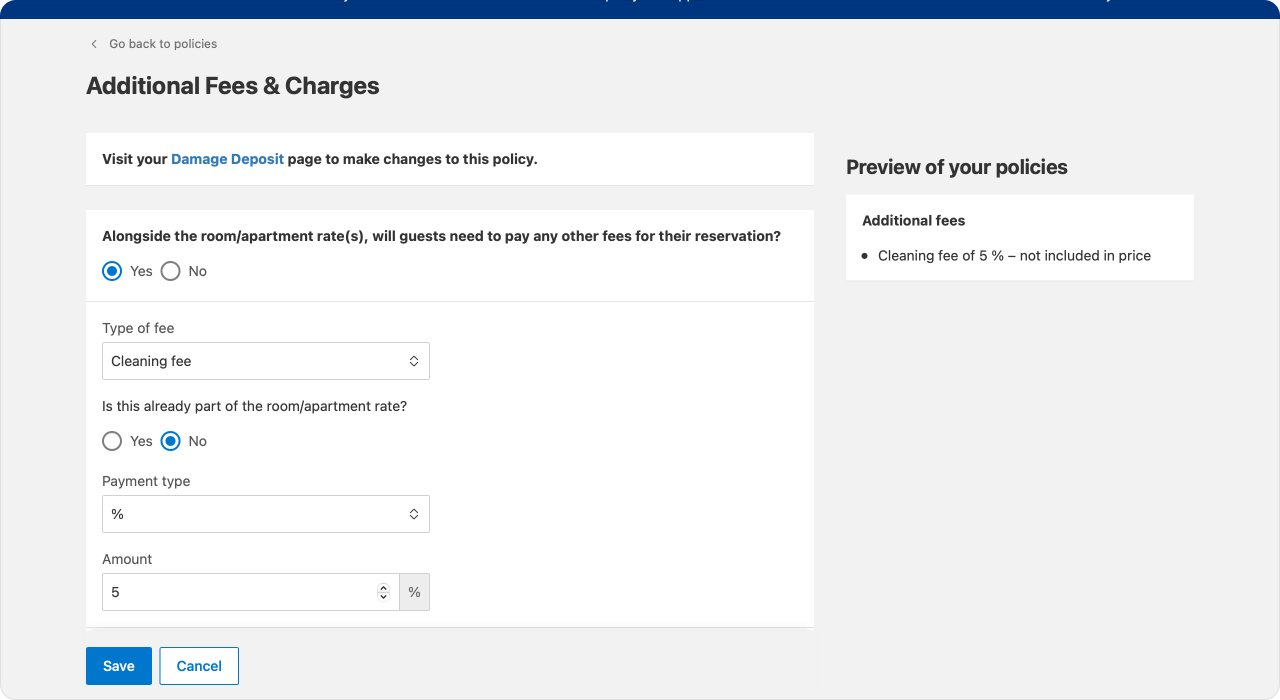
A damage deposit can help you to cover the potential damage caused by your guests. In the unfortunate event that something was damaged, you must use the misconduct reporting feature to report it to the Booking.com team.
Cancellation policy
You can create a number of policies for your property. A must-have policy is a cancelation policy.
Booking.com does not have a general cancelation policy. So, hosts can set their own rules regarding canceling.
For example, if you opt for a strict 14-day cancellation policy, be sure to create a prepayment. This way, you can charge your guest 14 days before their arrival.
Airbnb and Booking.com are two of the largest and most popular online booking sites. Therefore, listing your rental properties on both Airbnb and Booking.com is a smart move to maximize your reach and revenue.
However, both platforms have distinct characteristics that you should keep in mind when using these platforms.
Service fees
Currently, Airbnb offers two types of service fees to hosts, depending on your location. Hosts in certain countries can opt for a split fee. With the split fee, the service fee will be divided between the host and guest.
The guest will still pay the bulk of the service fee, which is about 14% of the reservation’s subtotal. Hosts will have to pay Airbnb about 3% of the total booking cost.
The second type of fee is the host-only fee. The host-only fee has replaced guests’ fees and instead the host will pay the entire service fee of about 14–16%. Hosts who opt for a strict cancelation policy will be charged more.
Booking.com does not allow you the option to split the fee with the guest. Hosts will be responsible for the entire service fee, which is typically 10 – 25%. As mentioned above, a commission may vary depending on the location and listing’s setup.
Cancellation policy
Airbnb has three main types of cancellation policies. These are flexible, moderate, and strict. Most guests prefer a flexible policy. This policy allows free cancellation, meaning guests can cancel their reservation 24 hours before check-in and still receive a full refund.
Thus, hosts who have opted for the flexible cancellation policy typically have a higher occupancy rate.
With Booking.com, they let you set custom cancellation terms and prepayment rules. Hosts have two options. If you have a free cancellation policy and a guest cancels, the guest will pay nothing and you will not be charged a commission.
If you do not have a free cancellation policy and guests cancel or don’t show up, they will pay you a fee and charge a commission on the amount that the guests have paid to you.
Instant book feature
Reservations on Booking.com are always instant. Airbnb allows hosts to choose whether they want to accept guests without prior communication.
However, the Instant Book feature is available on Airbnb as well. Airbnb encourages hosts to use Instant Book and gives a boost to the Instant Book listings in the search results.
Payment system
One of the major differences between Booking.com and Airbnb is that Booking.com allows using external payment services to send and receive payments. Guests can pay you online using different payment methods like a regular or virtual credit card, PayPal, AliPay, etc.
Hosts can also use Stripe to get paid on Booking.com. This can work well if you are using iGMS as you can connect your Stripe account to iGMS enabling you to receive payouts and generate invoices for all your reservations.
Marketing and visibility
Both platforms offer ways to boost your listing’s visibility, but they work differently. On Booking.com, programs like Genius, Preferred Partner, and Visibility Booster can help your property appear higher in search results or reach frequent travelers.
The trade-off is that joining these programs usually increases your commission.
Airbnb also has features to improve visibility, like Superhost status and promotional features, but these do not raise your service fees.
Loyalty program
Booking.com has a Genius program for loyal users. Once part of the program, guests will be lifelong members. For example, level 1 offers them a 10% discount on the price of their accommodation before taxes and charges are added.
Guests automatically join Level 1 by creating an account. They reach Level 2 by completing 5 stays in 2 years, and Level 3 by completing 15 stays in 2 years.
By qualifying for this rewards program, guests will find travel rewards wherever they decide to go.
Airbnb has no loyalty program.
The Best Practices for Vacation Rental Owners to Increase Reservations on Booking.com
Optimize your listing
Use clear, engaging language that highlights your property’s key features and amenities. Include popular search terms travelers might use. To stand out in search results focus on what makes your property unique, like a great view, modern kitchen, or pet-friendly policy.
Booking.com generates the initial description, so careful setup and profile completion are crucial for accuracy and listing appeal.
Upload high-quality photos
Photos should be bright, clear, and accurate. Consider adding captions that describe the space and include lifestyle shots that help travelers imagine staying there.
Set competitive pricing
Research similar properties in your area and adjust your rates to stay competitive. Booking.com provides built-in pricing tools for hosts.
This tool helps you analyze your market, compare your rates with similar properties, and adjust prices dynamically to stay competitive. You can set minimum and maximum prices, seasonal rates, and apply promotions or discounts directly from the Extranet.
Make your cancellation policy flexible
You can set a custom cancellation policy, but try to be as flexible as possible. Travelers want low-risk bookings. Guests are more likely to book if they know they can cancel or change plans without losing all their money.
Participate in visibility programs
Join programs like Genius, Preferred Partner, or Visibility Booster to improve your ranking in search results. These programs increase exposure to loyal and frequent travelers, which can boost occupancy and overall revenue.
Respond quickly to inquiries
Fast responses to messages and booking requests improve your ranking. Being proactive also builds guest confidence and can prevent cancellations due to unanswered questions. iGMS can automate your guest messaging and make guest communication a breeze.
Maintain high review scores
Encourage guests to leave reviews, reply to reviews politely, and address complaints promptly. Consistently high scores improve search placement and can attract more bookings from travelers who filter by rating.
Keep your calendar updated
Accurate availability improves search ranking and reduces headaches caused by overbookings. Use the iGMS channel manager to update your calendar across platforms automatically.
Set promotions and discounts
Booking.com lets you set discounts and special pricing. They’re called promotions and you create them through your Extranet under the Promotions tab.
You can offer different types of discounts that show up to guests when they search or book your property.
Here are common ways hosts can set discounts on Booking.com:
- Basic Deals — Standard discounts over a set period to make your property more attractive.
- Last‑Minute Deals — Discounts that apply only close to check-in to help fill open dates.
- Early‑Bird Discounts — Lower prices for guests who book far in advance.
- Mobile Rates — Special discounted prices visible only to travelers booking via mobile.
- Country/Geo Discounts — Set rates are shown only to guests from selected countries.
FAQ
What happens if I get double bookings?
If a guest books a room that’s already reserved, Booking.com still charges you commission because the room was listed as available. On top of that, you may need to cover costs to relocate the guest to another property.
The company expects hosts to manage availability carefully to avoid overbookings. That’s why channel managers for OTAs such as iGMS come in handy.
How do vacation rental owners handle multi-currency payments on Booking.com?
Booking.com allows you to set your preferred payout currency. The platform will convert guest payments from their currency to yours if needed, and you can view all transactions in your chosen currency on the Extranet.
Do vacation rental owners benefit from the Booking loyalty program?
The loyalty program itself isn’t a host reward program, but hosts indirectly see increased traffic and bookings.
However, hosts can participate in visibility programs like Genius, Preferred Partner, or Visibility Booster to see more bookings because these listings get more exposure.
How do vacation rental owners handle disputes or damage claims through Booking.com?
If a guest causes damage or disputes a charge, Booking.com allows you to report the issue through their Resolution Center or misconduct reporting feature. You submit evidence such as photos, receipts, or documentation, and Booking.com can mediate if the guest contests the claim.
Does Booking.com let you customize policies?
You can fully customize your cancellation and prepayment rules for each listing or room type. This includes setting how long before check-in guests can cancel for free, what fees apply for late cancellations, and whether prepayments or partial payments are required.
Can I link my vacation rental listing to multiple online travel agencies simultaneously?
Absolutely. The easiest way is through iGMS. As your property management system iGMS helps you manage all OTAs like Airbnb, Booking and Vrbo under one roof. One account, one inbox, one calendar, no double bookings.
Managing your multiple vacation rental listings can quickly turn into a hassle. That is why hosts are opting for software tools and solutions to streamline their businesses.
The seamless integration between iGMS and Booking.com offers loads of perks and benefits to iGMS users who also list on Booking.com. These include:
- Connecting existing Booking.com properties as well as creating new ones within the software
- Synchronizing reservations across multiple platforms to eliminate the risk of getting a double-booking
- Using automated templates and triggered messaging to improve guest communication
- Receiving payouts and creating invoices by connecting your Stripe account to iGMS
[ad_2]
Source link